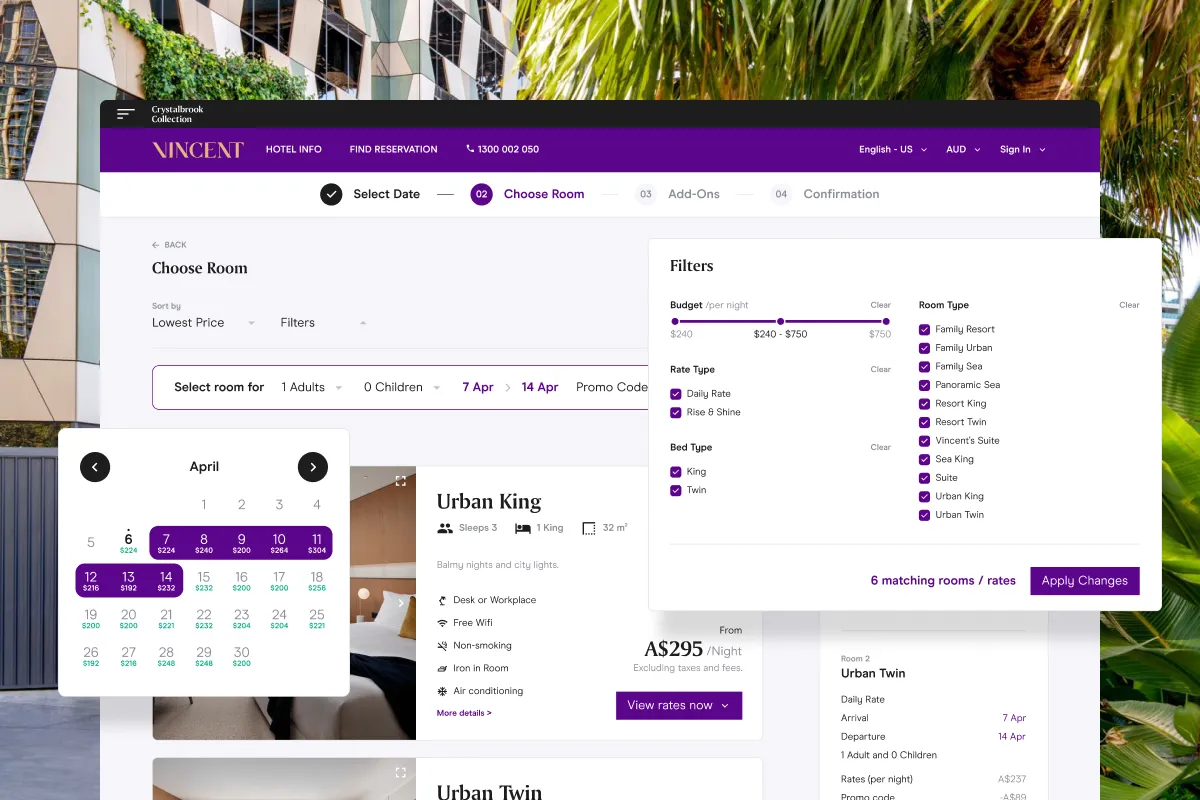
A PMS supports nearly every touchpoint in a typical day at a hotel. In the morning, staff can quickly check the day’s arrivals, departures, and room statuses in one view. Housekeeping sees which rooms need servicing and in what order, while the front desk is updated in real time as rooms are cleaned and marked ready.
As guests check in, the PMS provides staff with reservation details, payment status, and guest preferences. If a guest has stayed before, their notes are already saved, making personalisation simple. Throughout the day, teams can view occupancy, manage maintenance tickets, and make room or rate changes without delay.
Managers can monitor performance in the background, checking pacing, daily revenue, and upcoming bookings. At the end of the day, automated reports summarise activity and flag anything that needs attention.
This level of day-to-day visibility and automation frees up time for the team to focus on service, not systems.
A well-designed hotel property management system reduces stress by streamlining key operations. It helps hoteliers manage tasks with clarity and speed. Core functions include:
Together, these features form the backbone of a reliable PMS. When brought together in a single platform, they give your team a real-time view of everything happening across the property, without switching between systems or losing time to manual work.
1
Reservations and availability:
Updates bookings in real time and helps avoid overbookings.
2
Check-in and check-out:
Enables smooth guest arrivals and departures.
3
Payments and billing:
Handles secure transactions, invoicing, and financial tracking.
4
Housekeeping and maintenance:
Coordinates room status, cleaning schedules, and service issues.
5
Guest communication:
Automates confirmation emails, follow-ups, and personal touches.
Implementing the right PMS can unlock measurable benefits across your entire operation. These include:
Fewer booking errors thanks to live calendar syncing and automated updates
Faster check-ins and check-outs, improving guest satisfaction
Better housekeeping coordination, leading to cleaner rooms and quicker turnovers
Improved forecasting and reporting, helping managers make smarter decisions
A more personalised guest experience using saved preferences and notes
The real win? Your team spends less time on manual admin and more time delivering great service. That shows up in reviews, repeat business, and a smoother daily workflow. For more on this, see our guide to Increase Hotel Revenue: Essential Principles for Every Hotelier.
Implementing the right PMS can unlock measurable benefits across your entire operation. These include:
The real win? Your team spends less time on manual admin and more time delivering great service. That shows up in reviews, repeat business, and a smoother daily workflow. For more on this, see our guide to Increase Hotel Revenue: Essential Principles for Every Hotelier.
Implementing the right PMS can unlock measurable benefits across your entire operation. These include:
Fewer booking errors thanks to live calendar syncing and automated updates
Faster check-ins and check-outs, improving guest satisfaction
Better housekeeping coordination, leading to cleaner rooms and quicker turnovers
Improved forecasting and reporting, helping managers make smarter decisions
A more personalised guest experience using saved preferences and notes
The real win? Your team spends less time on manual admin and more time delivering great service. That shows up in reviews, repeat business, and a smoother daily workflow. For more on this, see our guide to Increase Hotel Revenue: Essential Principles for Every Hotelier.
There are a range of PMS options on the market, each with a different focus depending on the type and scale of property. Below is a quick comparison of some of the most commonly used systems:
Opera by Oracle
Best for: Large hotel chains and resorts
Key Features: Powerful and customisable, often used by enterprise-scale hotels. Requires setup and training.
Mews
Best for: Boutique and modern hotels
Key Features: Cloud-based with a strong focus on user experience and automation.
Cloudbeds
Best for: Hostels, B&Bs, and independent hotels
Key Features: Flexible and easy to integrate with other tools. Focuses on international properties.
Little Hotelier
Best for: Small properties and independent stays
Key Features: Simple, lightweight system tailored to smaller teams and low overhead.
Each of these PMS platforms has different strengths. The best choice will depend on your property type, your team’s experience with tech, and how hands-on you want to be with setup and ongoing management. Once you’ve chosen your PMS, a booking engine like Roomstay can help you capture more direct bookings and reduce OTA reliance.
Guests expect things to run smoothly. They want flexibility, quick service, and attention to detail, all without ever noticing the systems or effort behind it. For staff, that means staying on top of bookings, payments, room readiness, guest preferences, and team communication, often all at once.
Without a solid system in place, even the most experienced teams can run into trouble. Miscommunication, missed tasks, and manual errors start to add up. Things slip through the cracks. Service drops. And what started as a small issue becomes a poor review.
That’s where a property management system proves its worth. A good PMS brings structure to the chaos. It helps you manage bookings, track room status, communicate across departments, and keep guest information organised. It means fewer double-ups, fewer delays, and better day-to-day alignment.
It also gives managers a clearer picture of what’s happening, not just today’s check-ins, but which room types are booking fastest, what needs attention, and how performance is tracking overall.
The right hotel property management system software helps with:
This isn’t about chasing every new bit of tech. It’s about giving your team the tools to work smarter and deliver the kind of service guests remember for the right reasons.
What to look for in a hotel PMS
Choosing a PMS comes down to more than just brand names. The right system should match your operational goals and improve how your team works. Key features of hotel property management systems include:
Cloud access:
Enables remote use from mobile devices or off-site locations.
Integrations:
Connects with booking engines, payment processors, and third-party platforms.
Automation:
Reduces repetitive tasks and human error.
Reporting tools:
Tracks performance, occupancy, revenue, and guest behaviour.
Guest profiles:
Stores preferences, booking history, and notes for personalised service.
Hotel property management system software and hotel security
One of the lesser-known but significant benefits of a PMS is its role in keeping hotel data and guest information secure. Here’s how a property management system can help secure the hotel property:
When choosing a PMS, look for providers that use enterprise-grade encryption and secure hosting. Built-in access controls should let you decide who sees what, so sensitive data stays protected.
Secure payment gateways:
Protects credit card and billing information.
User access controls:
Ensures that only authorised staff can access sensitive data.
Cloud backups:
Reduces the risk of data loss from local hardware failures.
Audit trails:
Tracks changes and user activity within the system.
Roomstay is a direct booking platform designed to work alongside your PMS. It doesn’t replace your property management system. Instead, it connects to your existing PMS and helps you capture more direct bookings, reduce OTA commissions, and keep guests on your website.
The Roomstay platform includes three core products:
Booking engine: A high-converting checkout experience that captures direct reservations from your website. It syncs with your PMS in real time, so availability updates instantly.
RoomRate: Displays live room pricing directly on your website, so guests see real-time rates without needing to start a booking. It keeps visitors engaged and moving toward checkout.
RoomFinder: A widget that integrates into your existing website to streamline the booking process. It helps convert browsers into bookers by making it easy to search and select rooms.
These products work together to turn more website visitors into direct bookers. Your PMS handles the operations. Roomstay handles the conversions.
You don’t need to replace your PMS to boost direct bookings. Roomstay connects with the PMS you already use, adding a high-converting booking engine that turns more visitors into paying guests.
We handle setup, integration, and staff training, so you can start generating more direct revenue without interrupting operations. From day one, availability and rates sync instantly between Roomstay and your PMS, cutting out duplicate work.
Because most PMS systems lack advanced, guest-friendly booking flows, Roomstay fills the gap. It helps you capture more revenue, reduce OTA reliance, and keep control of your guest data. Less admin, more direct bookings, and a better experience for both guests and staff .
Want to see it in action? Book a free demo today.